random($foo)

Archive for the ‘Politics’ Category

Late Night Reading

Friday, April 19th, 2013

Transcript of secret meeting between Julian Assange and Google CEO Eric Schmidt

And I wanted there to be more just acts, and fewer unjust acts. And one can sort of say, well what are your philosophical axioms for this? And I say I do not need to consider them. This is simply my temperament. And it is an axiom because it is that way. And so that avoids, then, getting into further unhelpful discussions about why you want to do something. It is enough that I do. So in considering how unjust acts are caused and what tends to promote them and what promotes just acts I saw that human beings are basically invariant. That is that their inclinations and biological temperament haven’t changed much over thousands of years and so therefore the only playing field left is: what do they have? And what do they know? And “have” is something that is fairly hard to influence, so that is what resources do they have at their disposal? And how much energy they can harness, and what are the supplies and so on. But what they know can be affected in a nonlnear way because when one person conveys information to another they can convey on to another and another and so on in a way that nonlinear and so you can affect a lot of people with a small amount of information. And therefore you can change the behaviour of many people with a small amount of information. So the question then arises as to what kinds of information will produce behaviour which is just? And disincentivise behaviour which is unjust?

Thinking about this in context of the events unfolding in Boston, and the crowdsourced attention happening among other things.

Some Notes on Labor, Technology and Economics

Tuesday, March 26th, 2013

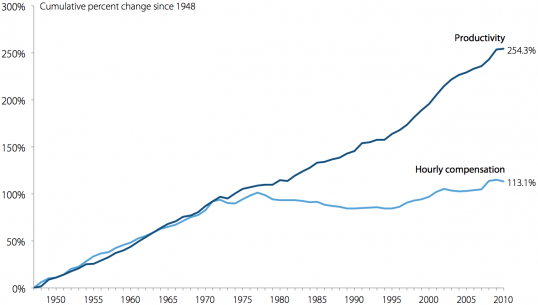
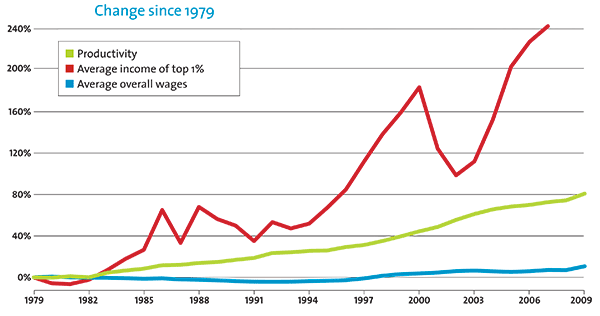
I think that we are all aware that advanced capitalism is leading us down a road that as a society, we may not want to travel – constant crisis due to increasingly advanced, complex, and unstable financialization, an increasingly vicious trend toward plutocracy and plutonomy that has obliterated socioeconomic mobility via massively increasing inequality, and of course, as an engine of unsustainability, where environmental, health, and social costs are externalized and reality is subsumed via a twisted economic logic.

All these things really should be teased out into much larger discussions, but a few recently related links/discussions I want to make note of (I’m slowly moving some things back out of Evernote into a way that can be narratized):

  • HN: Confessions of a Job Destroyer – a good essay that highlights what technological “disruption” really means; relevant to software, robotics and all sorts of enabling technologies
  • HN: Unfit for work (npr.org) – NPR is doing a weeklong series on how the disability program is hiding massive collapses in the workforce

Also, this image popped up in my Twitter stream recently…

A quick Google search shows that it’s been floating around for at least a year, and the bottom text references an organization that ceased to exist in 1982 so it is probably quite old, but still resonates as much (if not more) today. Here’s the text transcribed (via)

If you’re unemployed it’s not because there isn’t any work

Just look around: A housing shortage, crime, pollution; we need better schools and parks. Whatever our needs, they all require work. And as long as we have unsatisfied needs, there’s work to be done.

So ask yourself, what kind of world has work but no jobs. It’s a world where work is not related to satisfying our needs, a world where work is only related to satisfying the profit needs of business.

This country was not built by the huge corporations or government bureaucracies. It was built by people who work. And, it is working people who should control the work to be done. Yet, as long as employment is tied to somebody else’s profits, the work won’t get done.

- The New American Movement (NAM)

Searching for this led to this interesting article:

Looking Back, Looking Forward

Friday, December 31st, 2010

Charlie Stross posted an interesting essay today, Reasons To Be Cheerful recapping some of the great things that have happened in the world over the past decade, primarily in the developing world. A great read, and honestly inspiring/heartwarming for the disheartened humanists. It’s easy to get overly cynical about it all. This is a good antidote.

That being said, I don’t think Charlie goes quite far enough. The essay starts framed by the thesis that in the world, things haven’t much improved, and the besides a few specific counterpoints about disease and the general march of technology, it feels like he gives up on really repudiating that thesis… for the developed world. And it’s easy to see why. In terms of general socio-economic trends, it’s hard to be all that positive. Things are downright unsettling heading towards dystopian. However, there’s at least one aspect, the very medium where we are commenting on that is worth, uh, commenting on.

Yes, the interwebbytubes, as Stross puts it, is quite a different place than it was at the beginning of the millennium. We are looking at a 2X adoption growth in developed nations (from plurality to supermajority, if not ubiquity). Worldwide, 2 billion people are now online. Beyond the quantitative changes, the qualitative changes are even more intriguing. In 2000 there was no Web 2.0. Blogging was in its infancy. Most of the things we take for granted online today were not invented yet. Among them: Wikipedia (2001), Facebook (2004), Google Maps (2005), Twitter (2006). I list these in particular because I don’t think there’s a day that goes by where I don’t use these particular services, but I’m sure that others have their own lists. Lest you think that this was a singular period of growth, I’ll throw in that the iPhone (2007) and iPad (2010) have kicked us into another era of hyper-growth that will be just as (if not more) life-changing.

We’re just starting to see what happens when the Internet starts engaging with us in a location/context aware fashion. We’re also starting to see what happens when Internet-style/scale dynamics are applied outside traditional consumer Internet contexts (e.g. Obama Campaign, 2008). In a historical scale, we’re still at the very beginning stages of figuring out what it means to live in a digital, massively inter-networked world, and similarly just starting to get a handle how that will change society (attention, communications and collaboration in particular).

All that’s a really long way of saying… well, there’s a pretty dang bright spot in the developed world too. One that has the potential of being turned into the shovel we need to dig ourselves out. So, here’s looking to the future. Happy New Year.

Wikileaks, Net Neutrality, Architectures of Participation

Friday, December 24th, 2010

This post is mostly a placeholder/notes for further thinking I’ve yet to do about a few related threads that seem connected this past week. Before, but particularly since my experience working on the 2008 Obama campaign, I’ve been thinking about the most potentially transformative aspects of the technologies that we deployed: specifically, deploying methods and means for self-directed organization and participation.

In the meantime, the things that some things that have caught my attention.

In regards to the capitulation of Net Neutrality, this thread on building a alternative mesh network. I wonder if it’ll come to that?

On Gitmo and normalization of indefinite detention, davidasposted’s sobering analysis of the situation.

And of course, there is Bruce Sterling’s Wikileaks missive – melodramatic, oversweeping, but truly compelling, and a must read (counterpoint).

Also, Julian Assange’s impressively articulate recent interviews, and more information on Bradley Manning’s continued mistreatment.

On the TSA

Thursday, November 18th, 2010

I’ve flown a fair amount over the past few years, through many airports in the US and abroad.  The International Terminal at SFO was one of the first places I regularly fly through (Virgin America’s HQ/hub) that had “Advanced Imaging Technology” aka the porno-scanner installed.  Still, with the ability to choose your line (and looking on with some morbid fascination that people didn’t realize what they were exposing and being exposed to), I was able to for the most part, avoid this particular security theater for quite a while.  It wasn’t until this spring that I was finally confronted with having to opt out – which I did.

Like many others (and a couple friends it turned out), I experienced first hand TSA’s efforts to berate and attempt to humiliate me, which seemed like SOP to cow myself and others into not opting-out.  This, btw, included repeating the lie that this wasn’t an abrogation of the 4th amendment (which apparently some people fought about a while back and started some country or something), and that I had no right to fly. As pointed out in a recent thread, this is patently not the case either in law (“A citizen of the United States has a public right of transit through the navigable airspace”) or in case law (Kent v. Dulles (1958) – “The right to travel is a part of the ‘liberty’ of which a citizen cannot be deprived without due process of law under the Fifth Amendment”). This was pre “enhanced pat-down” aka groping of the genitals (FYI, the San Mateo DA has promised to prosecute inappropriate pat-downs as sexual assault). In any case after an exchange with @TSABlogTeam that about my treatment, I filed an official complaint online, which obviously had no effect whatsoever.

It’s somewhat of a relief to see this finally get some mainstream attention, and for people to really start thinking about what a decade of the TSA and it’s accompanying security theater really means.  In my view, even leaving out the basic civil rights issues, on the issue of basic competence and effectiveness, there has been a serious lack of overall seriousness in actual security – professionalism and training of agents is severely lacking and uneven, and the (completely arbitrary, ever-changing, secret, and again, unevenly applied) rules are mostly hare-brained and don’t pass basic common-sense sniff tests (much less any formal analysis of effectiveness, or real security/threat modeling).

At this point, a decade in, the TSA is a complete failure.  It has no credibility, even as security theater. If it were up to me, the only way that the TSA would be allowed to continue is that, as suggested on this recent GovLoop thread, that a serious government or independent panel were to publish cost/benefit and full risk analysis studies of their procedures.  Beyond that, public accountability in the form of published results for regular pen-testing/other basic quality assurance procedures to make sure that guidelines were being followed and that citizens are treated, well, as citizens would be another requirement.  The TSA as it stands, both as an institution and as an organization betrays the principles and basic laws that the US was founded on, paid for in blood by our predecessors.

That being said, my hopes are dim for any real reform to happen.  It’s probably best summed up in this comment from that same GovLoop thread. (This comment is what finally got me to sit down and write down some of my thoughts on the matter):

6. We are not talking inconvenience. We are talking abrogation of fundamental 4th amendment rights and the reduction of our society to a thinly vieled police state. The most shameful aspect of the entire situation is that we allow TSA and other law enforcement agencies to slowly and steadliy chip away at our freedoms because we are too scared or compliant to resist. I fly about 2-4 times a year, usually for vacations and will continue to do so. I have and will continue to stand in the machine and allow TSA work their will because I am more interested in getting on with my trip than in standing up for my rights. I am ashamed of this fact and bitterly resent TSA for forcing me to realize that in at least one sense, I am a moral coward. I strongly suspect that a large part of the backlash currently directed at TSA comes from people who share my views, share my moral cowardice, are equally ashamed of it and are looking for ways to resist without ending up on a no fly list.

In all likelyhood TSA will “win” this fight. Our rights will degrade a little more each year and few if any of us will ever offer any meaningful resistance. It is a sad commentary on our nation and our culture that we have allowed and will continue to allow law enforcement (not just TSA) do erode our basic values and do more harm to our nation than any terrorist could hope to accomplish in their wildest dreams.

For the first time in years, I don’t have any flight plans lined up.  It’s a good opportunity for me to think long and hard about what the correct moral stand is.

Software Patents

Tuesday, August 17th, 2010

Every so often, I’m glad I sometime click into the comments on /.

The software industry is more affected because it depends much more on innovation than other industries.

In particular, it depends on the incremental innovation, whereas almost all new inventions are typically (and in some cases by logical necessity) are old inventions slightly reconfigured. Patents stop the incremental innovations in its tracks, since an “inventor” of a killer app has all the reasons to sue everyone in sight and none of the reasons to improve on the app. And even if the patent holder does use the monopoly profits to innovate further, it cannot possibly make up for excluding everyone else from the process. Imagine for a moment that a compiler was patented. Only a few biggest players could then afford licenses required to develop commercial software, and free OSes like BSD or GNU/Linux would be illegal. Proponents of software patents must admit that that is the way we should have went: if anything deserves to be called an innovation in software, a compiler certainly does. They also must close their eyes on the fact that the free software community produced and now maintains not one, but two best OSes of today, while competing with an entrenched monopolist. Anyone who believes that software patents are producing any good for the society is either grossly misinformed about the software market or is an enemy of the public (that is, a corporate cock sucker) and a hater of the computer science in general.

More on Iran

Tuesday, June 16th, 2009


Also, as you might expect,538 has been posting some interesting analysis on the election numbers…

And Alan has posted a photo set on the Big Picture.

It looks like HuffPo has a writer live blogging developments, including a just updated report that recounts will be held.

If You’re not paying attention to Iran…

Sunday, June 14th, 2009

…right now, you should be.

Jim Cramer on The Daily Show

Friday, March 13th, 2009

Jon Stewart is able to articulate some of the things that are so exasperating about this whole situation and that the “real” media has been remiss on. Worth watching.

For geeks wondering about whether these systemic issues might be fixable, Toby Segaran and Jesper Andersen gave an interesting talk at ETech about developing a more robust credit rating system (it picks up in the last third where they start demoing what they’ve been doing). Check out Freerisk to see what they’re up to.

Stimulus 101

Monday, February 9th, 2009

I’ve been otherwise occupied this month, so I’ve only had a chance to keep an intermittent eye on the Stimulus Plan and its development. One of the things that I was a bit disappointed to find is that despite the copious amounts back-and-forth prattle coverage and the much better ongoing discussions in the economic/biz blogs that I follow, that I couldn’t find a really good single page/resource for describing in simple, understandable terms what’s happening to the economy and why economic stimulus is needed and how the plan will help.

One of the first places I went to was WhiteHouse.gov and the complete failure in communicating and selling the stimulus plan on there, especially coming from my experience on the campaign, was a (surprising) failure on the part of the Obama administration. And, while I think that this past week has been much better with the President’s recent WP op-ed and tonight’s press conference (video), I think that having a good, concise one-pager would still be an enormous benefit.

It’s one thing to talk about a full-blown crisis, but an image like this (posted Friday on Nancy Pelosi’s blog) makes things much clearer:

Job Losses in Recent Recessions

(Here’s a version with job losses from all post-WWII recessions, although I don’t know if they’re using consistent measurements)

Also, from a understanding macro-economics or fractional banking perspective, I think that there’s a pretty big gap in terms of understanding what’s going on (about 3min in to hear about the details of the bank run):

For me, the things I’d be most interested in are the economic projections (job losses? GDP shortfall?) and accessible breakdowns of the stimulus plan effects (hint: a 100pg PDF is not the ideal format), the effects of the infrastructure investments, and comparisons of tax cuts vs direct spending:

Fiscal Stimulus Bang for the Buck

Lastly and perhaps most importantly I think is that spotlight on the economy needs to force us to talk about and address the huge structural problems that we’ve been ignoring – sustainability of growth, consumption, income inequality, etc. Here’s a video of Robert Reich discussing some of this:

While I’m disappointed that neither the MSM nor the Stimulus Plan backers have done something like this, it’s occurred to that this is the perfect sort of project some good designers to tackle in conjunction w/ either some of the economist bloggers that have covering this stuff or some of the civic groups out there. (Just saying.)

(FWIW, I recently started reading Krugman‘s The Return of Depression Economics and the Crisis of 2008 which has been pretty interesting so far. For those looking for a better idea of how our money and our economy works, Chris Martenson’s Crash Course is good (and depressing) start. The Wikipedia entry on the Economy of the United States is also a good place to start surfing.)